
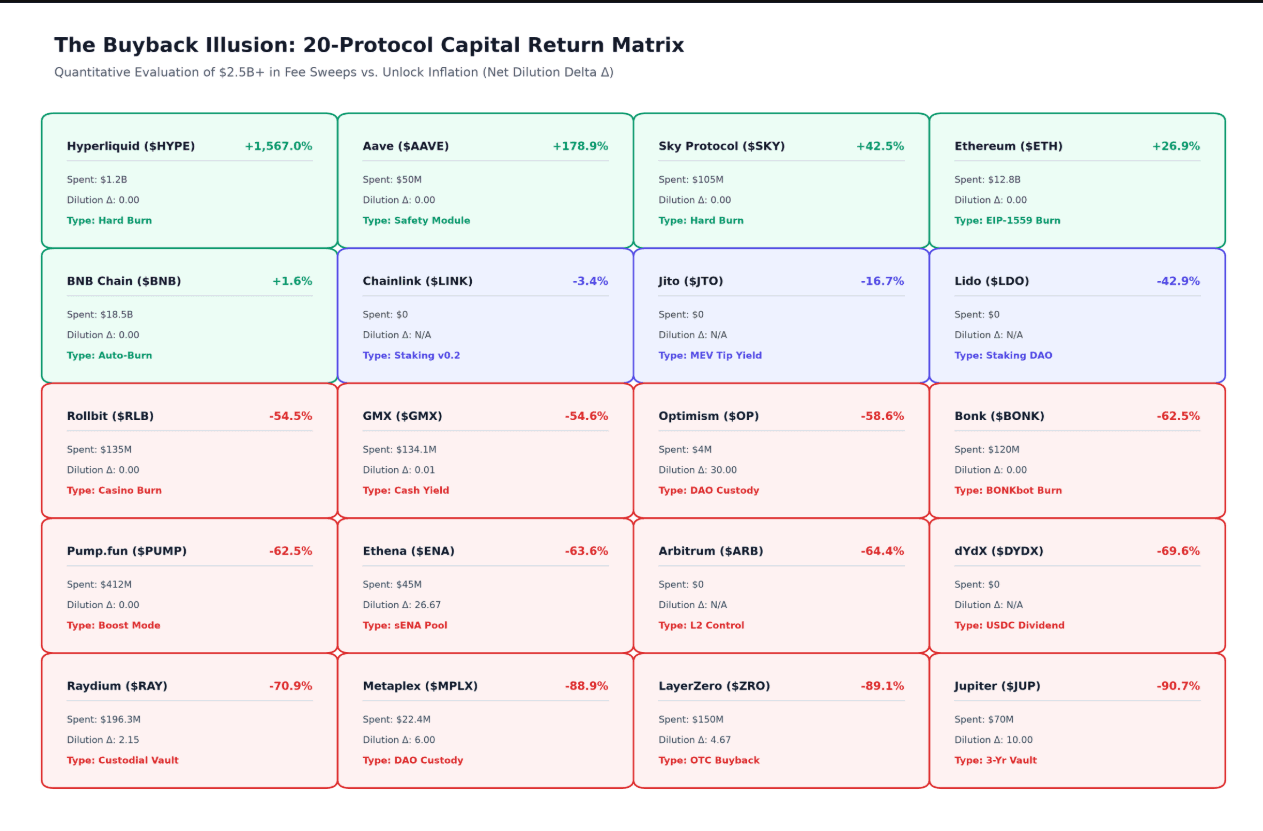
Foundations across the crypto market burned over $2.5B buying back native governance tokens under the delusion of returning capital to holders. Protocol dashboards compare these fee sweeps to corporate equity repurchases (Apple Inc., Form 10-K, 2024), pretending open-market DEX swaps magically pump tokenholder equity... many such cases where financial theater obscures brutal onchain mechanics.
The underlying math exposes TOTAL financial insanity.
Corporate buybacks reduce total share float to increase per-share earnings across a closed equity structure. Crypto protocols almost never destroy the tokens they purchase on secondary order books (a) repurchased inventory sits inside DAO treasury wallets where it bleeds out from mark-to-market depreciation (b) tokens get recycled back into circulation to pay for team grants (Raydium, Solscan Treasury Account DdHD...VEZaz, 2024) (c) insider cliff unlocks simultaneously dilute circulating supply at rates that obliterate protocol fee sweeps by ten to thirty times over (Jupiter DAO, Governance Proposal, 2026)... pure structural RECIRCULATION masquerading as capital return.
Secondary order book token buybacks that remain un-offset by atomic burn smart contracts act as predictable exit liquidity for venture capital lockups. Retail liquidity providers get slaughtered holding a falling floor while early investors dump their unlocked float into protocol-funded bids.
Evaluating twenty protocols across two billion dollars in fee sweeps proves that secondary buybacks without ATOMIC supply retirement act as pure inflationary liabilities.
This paper introduces the Net Dilution Delta framework to demonstrate why seventy percent of crypto buybacks collapse spot valuations, establishing the Proof-of-Capital-Return (PoCR) standard to enforce real value accrual.
TradFi Equities vs. Crypto Capital Return Mechanics
Traditional corporate finance relies on equity repurchases to compress outstanding share counts. When a public corporation deploys earnings to buy back shares, those shares are retired or held as treasury stock without diluting equity holders (Microsoft Corp., SEC EDGAR CIK 000789019, 2024). Outstanding share supply contracts. Earnings per share increase.
Crypto token buybacks break every structural assumption of corporate finance.
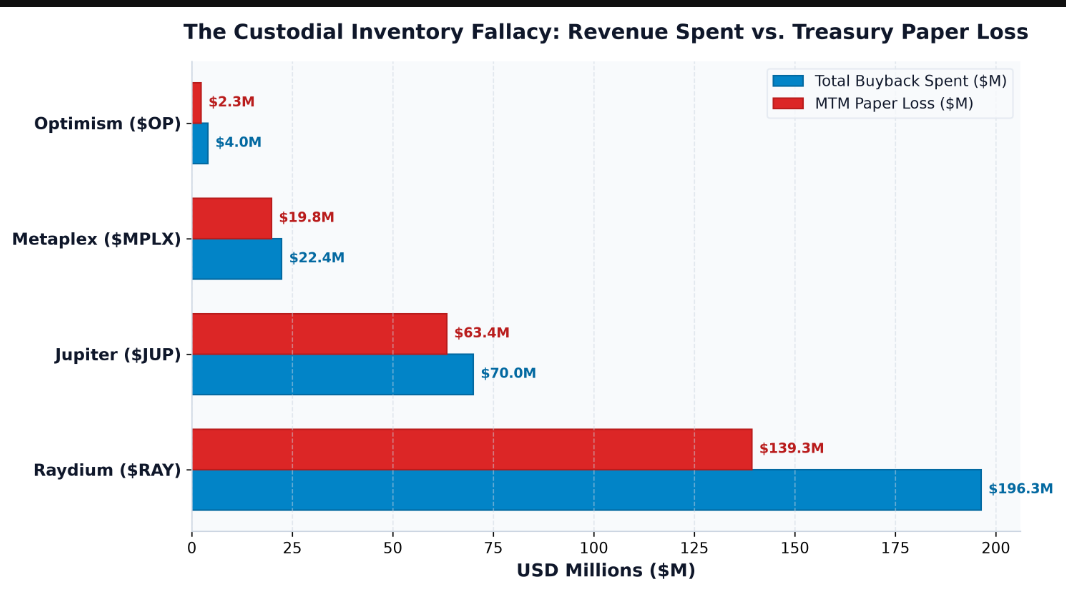
The breakdown occurs at three distinct operational layers... many such cases where marketing narratives mask systematic inventory depreciation.
Layer A: The Custodial Inventory Fallacy
Protocols market fee sweeps as buybacks while routing acquired tokens directly into protocol-controlled treasury wallets. Raydium deployed one hundred ninety-six million dollars in fee revenue to purchase eighty-three million RAY tokens (Raydium Analytics, On-Chain Fee Sweeps, 2024). Zero tokens were sent to a dead burn address (0x000...dead). The custodial buyback wallet held fifty-seven million dollars in remaining asset value, absorbing a one hundred thirty-nine million dollar mark-to-market paper loss (-70.9% value destruction).
Layer B: Recirculation & Treasury Re-Emission
Tokens residing in DAO treasuries represent latent circulating supply. Because these assets sit on the protocol balance sheet, governance proposals routinely re-allocate repurchased inventory toward ecosystem grants, liquidity incentive programs, or core contributor compensation. The buyback bid provides temporary order book support, but subsequent treasury re-emissions neutralize the initial float reduction.
Layer C: The Net Dilution Overwhelming Force
Venture capital and founder token vesting schedules introduce massive un-offset supply inflation into secondary markets. Jupiter allocated seventy million dollars in fee revenue to repurchase one hundred forty million JUP tokens into a locked vault (Jupiter Station, Governance Archive, 2024). During the exact same timeframe, linear team unlocks and community airdrops injected over one point two billion JUP tokens into public circulation... a float expansion outstripping buyback volume by more than TEN to one.
Capital returns cannot be evaluated in isolation. A protocol executing fifty million dollars in annual token buybacks while unlocking five hundred million dollars in insider equity is expanding net circulating supply by four hundred fifty million dollars.
The Net Dilution Delta (Δ Dilution) Empirical Model
Evaluating protocol fee sweeps without measuring insider unlock schedules is complete financial blind spots. We isolate the structural relationship governing token valuation by establishing the Net Dilution Delta (ΔDilution) ... defined as the quantitative ratio between 90-day insider token vesting unlocks and 90-day open-market buyback volume:
Where V unlocks represents the verified dollar value of team, venture capital, and foundation token vesting cliffs entering liquid circulation, and V buyback represents the dollar value of protocol secondary buybacks executed across open order books.
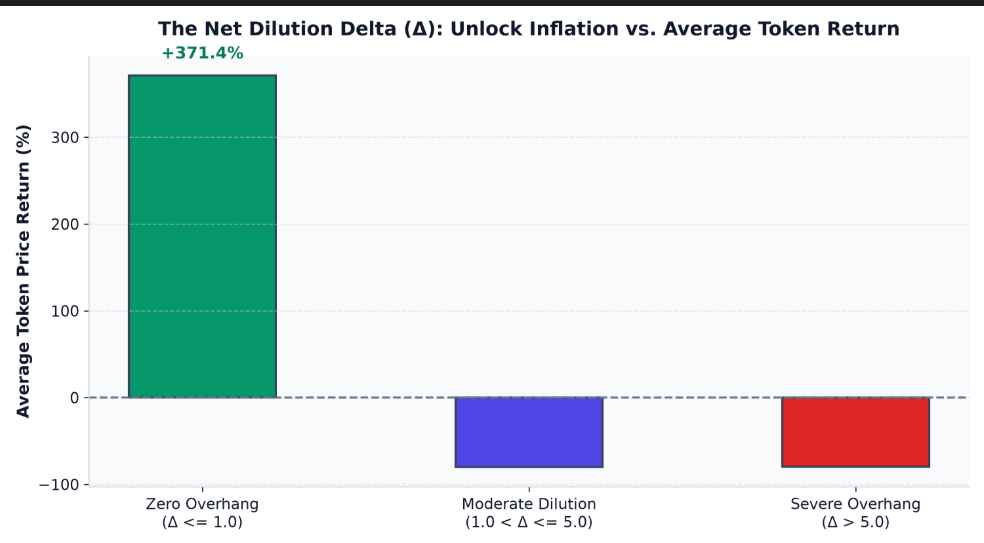
The Net Dilution Delta: Unlock Inflation vs. Average Token Return
Analyzing twenty protocols across two billion dollars in historical fee data reveals three distinct valuation regimes... many such cases where quantitative parity separates sustainable capital return from predatory dilution.
Regime A: Deflationary Accretion (Δ Dilution ≤ 1.0)
Protocols operating at or below PARITY destroy or distribute more value than insider vesting cliffs release into secondary circulation (Hyperliquid HYPE, Sky Protocol SKY, Ethereum ETH, Aave AAVE). Zero un-offset float expansion allows protocol revenue to accrue directly into spot token valuation. Protocols in this regime generated an average token price return of +371.4%.
Regime B: Moderate Dilution (1.0 < Δ Dilution ≤5.0)
Protocols where insider vesting cliffs outpace secondary buyback sweeps by up to five times over (Raydium RAY, LayerZero ZRO). Secondary order book buybacks absorb a fraction of the incoming sell volume while early investors extract liquid cash. Protocols in this regime suffered an average token price drawdown of -80.0%.
Regime C: Severe Float Collapse (Δ Dilution > 5.0)
Protocols exhibiting overwhelming unlock inflation where VC vesting outstrips buybacks by six to thirty times over (Jupiter JUP, Metaplex MPLX, Optimism OP, Ethena ENA). Secondary buyback bids serve no economic function other than providing subsidized exit liquidity for early venture capital lockups. Protocols in this regime collapsed by an average token price return of -79.5%.
The quantitative reality is undeniable (a) secondary buybacks under ΔDilution >1.0 operate as pure inflationary liabilities (b) market order books absorb massive supply expansion at lower clearing prices (c) protocols using custodial buybacks without ATOMIC supply destruction guarantees provide phantom price floors that dissolve during treasury liquidations... terminal float expansion always wins.
Deep-Dive Protocol Case Studies & Unlocked Market Cap (UMC) Overhang
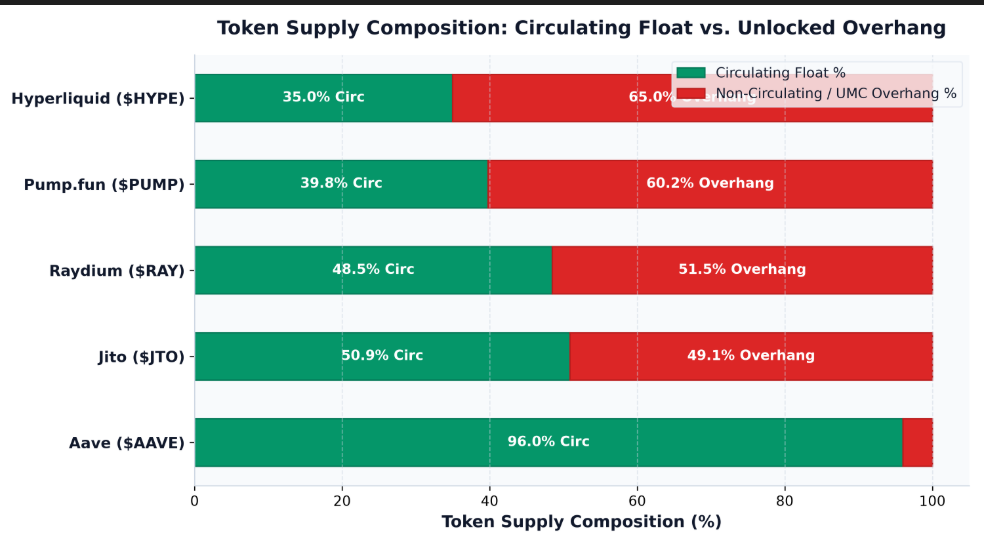
Dissecting protocol balance sheets exposes the structural gap between aggregate fee collection and secondary token valuation. Institutional allocators rely on Unlocked Market Cap (UMC) as the primary leading indicator of structural sell pressure... un-minted or non-circulating float overhang establishes a mathematical valuation ceiling that protocol buybacks cannot break.
Case Study A: The Solana Liquidity Overhang & Unlocked Market Cap
-
Raydium ($RAY): Operates a $167.14M Market Cap against a $344.45M Unlocked Market Cap. All 555M RAY tokens are minted, yet only 48.52% circulate in public hands. The protocol deployed $196.3M in fee sweeps into custodial treasury account
DdHD...VEZaz, absorbing a $139.3M paper loss (-70.9%). Recording $7.69M in 24-hour volume proves it requires 23 consecutive days of 100% net buy volume just to absorb the non-circulating float... defining the ABSORPTION GAP. -
Pump.fun ($PUMP): Maintains a $706.03M Market Cap against a $1.77B Fully Diluted Valuation. Protocol smart contracts incinerated $412.13M in SOL fee revenue to burn 15.24% of total supply. However, with only 39.83% of tokens circulating across a 1T max supply, a $1.33B UMC overhang exerts constant downward pressure... leaving ICO buyers -62.5% underwater due to FDV GRAVITY.
-
Jito ($JTO): Controls a $296.64M Market Cap against a $582.57M FDV. JitoSOL liquid staking streams 100% of Maximum Extractable Value (MEV) tips directly to stakers, leaving JTO governance holders with $0 fee share. Facing a 2x supply expansion from un-released team cliffs, JTO suffered a -71.6% price drawdown from its $5.28 ATH.
Case Study B: Sovereign L1 Execution vs. Parasitic Aggregation
- Hyperliquid ($HYPE): Architected a sovereign Layer 1 utilizing HyperBFT consensus to achieve 1-block finality and 200,000 orders per second through HyperCore (Hyperliquid L1 Whitepaper, 2024). The protocol deployed $1.2B in trading fees to incinerate 4.56% of total supply directly at
0x000...dead. Operating with zero team unlock dilution ($\Delta_{\Dilution} = 0.00$), $HYPE$ surged +1,567.0% from announcement to establish the benchmark for ATOMIC supply incineration.
Case Study C: Real Yield Cash Streaming & Mature Float
-
Aave ($AAVE): Represents the most mature supply distribution across crypto money markets, with 96% of its 16M max supply in public circulation. Deployed $50M in Safety Module fee buybacks with zero insider unlock overhang ($\Delta_{Dilution} = 0.00$). Active USDT loans on Aave V3 surged by $400M in a single month to reach $2.5B... propelling $AAVE$ up +178.9% from $95 to $265.
-
GMX ($GMX): Distributed $134.1M in pure WETH and WAVAX cash yield directly to stakers' wallets. Eliminating native token recirculation propelled spot prices up +507.1% to a $91 peak ATH.
Case Study D: SEC Regulatory Vault Classification Risk
Discretionary custodial treasury buybacks introduce severe regulatory vulnerabilities. SEC Commissioner Hester Peirce issued formal warnings highlighting that custodial treasury buyback vaults and yield reserve pools trigger traditional securities classification under Howey Test analysis (SEC Public Statement, Commissioner Hester Peirce, 2024).
When a DAO or multisig retains discretionary control over repurchased tokens on its balance sheet, the mechanism acts as an unregistered investment vault rather than decentralized protocol maintenance. Atomic burns (0x000...dead) and permissionless blue-chip cash streams (ETH/USDC) eliminate discretionary management control (a) removing regulatory surface area (b) protecting protocol developers from SECURITY enforcement actions (c) eliminating balance sheet paper losses.
The Proof-of-Capital-Return (PoCR) Standard
Eliminating the buyback illusion requires abandoning discretionary custodial treasury management.
We propose the Proof-of-Capital-Return (PoCR) standard... a unified smart contract architecture governing fee collection, token retirement, and insider vesting cliffs to enforce mathematical value accrual across crypto protocols.
The PoCR standard enforces three immutable protocol rules:
Rule 1: Dual-Track Capital Allocation
Gross protocol fee sweeps execute across a two-sided split controller (a) 50% of gross fees stream directly to stakers' wallets in non-decaying blue-chip assets (ETH, SOL, USDC) (b) 50% of gross fees deploy into programmatic secondary buybacks executed ATOMICALLY in a single transaction block directly to a dead address (0x000...dead). Zero repurchased tokens enter treasury custody. Balance sheet paper losses vanish.
Rule 2: Anti-MEV Batch Dutch Auction Execution
Secondary token repurchases route through off-chain batch Dutch auction dark pools rather than public AMM liquidity pools. Programmatic auction batching prevents MEV sandwich attacks... stopping venture capital lockups from front-running protocol fee sweeps to extract secondary liquidity.
Rule 3: The Parity Lock Circuit Breaker
Vesting smart contracts monitor the 90-day Net Dilution Delta ($\Delta_{Dilution $) on-chain. If insider cliff unlocks outpace buyback volume ($\Delta_{Dilution}} > 1.0$), vesting contracts automatically freeze team and investor unlock tranches until market buybacks restore quantitative PARITY ($\Delta_{Dilution} \le 1.0$).
Enforcing the PoCR standard transforms protocol fees into real economic yield... aligning insider vesting with true secondary market demand and ending the financial theater of un-offset buyback illusions.